Fluid Bed Dryer: Working Principle, Types, Applications and Design
Fluid Bed Dryer is an industrial drying system used to remove moisture from powders, granules, crystals and other particulate materials by bringing the product into contact with a controlled stream of heated air. The technology is widely used in pharmaceutical, food, nutraceutical, chemical, agrochemical and other process industries where controlled and efficient drying is required.
Unlike conventional drying systems in which material may remain stationary during most of the drying cycle, a Fluid Bed Dryer uses upward-moving air to suspend and move particles within the drying chamber. This fluidization creates intimate contact between the drying air and the product, supporting effective heat and mass transfer.
The actual design and operating conditions of a Fluid Bed Dryer depend heavily on the properties of the product being processed. Particle size, density, moisture content, temperature sensitivity, flowability, required final moisture and production capacity all influence equipment configuration.
What Is a Fluid Bed Dryer?
A Fluid Bed Dryer is a process machine designed to reduce moisture in particulate materials by passing conditioned air through a perforated or specially designed air-distribution system at a controlled velocity.
When the upward air velocity reaches an appropriate level, particles begin to move and become suspended. The resulting condition is known as fluidization. In this state, the particles behave in a manner somewhat similar to a fluid, allowing drying air to contact a large portion of the available particle surface.
The basic process can be represented as:
Filtered Air → Heating → Air Distribution → Fluidization → Heat Transfer → Moisture Evaporation → Moist-Air Exhaust
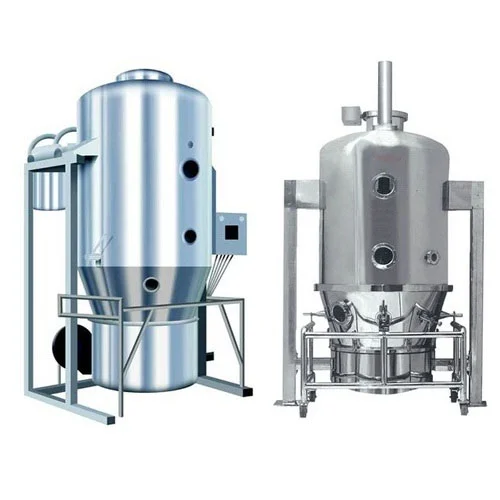
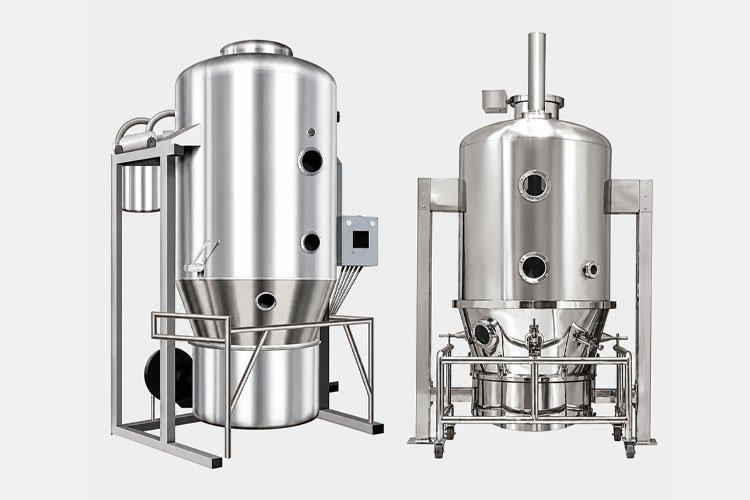
A typical Fluid Bed Dryer consists of an air handling section, filtration system, heating arrangement, blower, product container or drying chamber, air distributor, product-retention/filter arrangement, exhaust system and process control system. The objective is not simply to increase temperature. A properly designed dryer must establish suitable relationships between air temperature, air velocity, airflow, product loading, particle characteristics and drying time. This is particularly important for pharmaceutical and food products, where excessive temperature or prolonged drying can affect product quality.
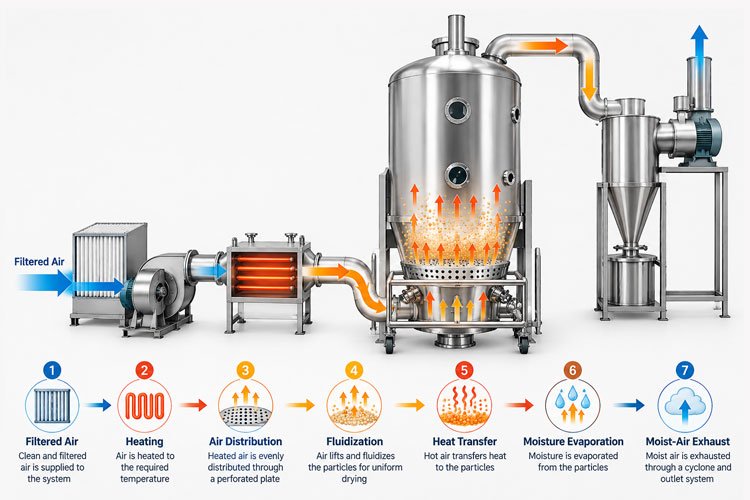
How Does a Fluid Bed Dryer Work?
The working principle of a Fluid Bed Dryer is based on controlled airflow through a bed of wet particles. The process normally takes place through several stages.
1. Product Loading
The wet product is introduced into the product bowl or drying chamber. The quantity of product loaded must be appropriate for the equipment’s design and the product’s fluidization characteristics. A machine should not be selected solely on the basis of nominal chamber volume because the usable product capacity depends on bulk density, particle characteristics, bed depth and fluidization behavior.
2. Air Filtration
Ambient or process air enters the air handling system. Depending on the application, the air can pass through multiple filtration stages. The filtration arrangement may include pre-filtration, fine filtration and, where required by the process, high-efficiency filtration. The filtration system helps control particulate contamination and protects the product and downstream equipment.
3. Air Heating
Filtered air is heated to the required process condition. Depending on the application and available utilities, heating may be achieved using an appropriate heating arrangement such as electrical heating, steam heating, thermal-fluid heating or another engineered system.
The selected heating method depends on:
- Required temperature
- Heating duty
- Available utilities
- Plant infrastructure
- Product characteristics
- Installation environment
- Process control requirements
4. Air Distribution
The heated air reaches the air-distribution section. A distributor plate or other engineered air-distribution arrangement helps distribute airflow across the product bed. Uniform airflow is essential. If certain areas receive substantially more air than others, the product may experience uneven fluidization and consequently uneven drying.
5. Fluidization
As air passes upward through the product, the particles begin to move. When the airflow reaches a suitable condition, the particles become suspended and continuously mixed by the air stream. This creates the fluidized bed.
The exact airflow requirement depends on:
- Particle size
- Particle density
- Particle shape
- Bulk density
- Product moisture
- Bed depth
- Particle cohesion
- Equipment geometry
6. Heat Transfer
The heated air transfers thermal energy to the wet particles. Because the particles are continuously exposed to moving air, the contact area between the product and drying medium can be substantial. Heat transfer causes moisture within the product to migrate toward the surface and evaporate.
7. Moisture Evaporation
As moisture evaporates, it enters the air stream. The resulting air becomes more humid and must be removed from the drying chamber. Drying therefore involves both heat transfer and mass transfer. The process can be affected by the moisture content of the incoming air, product temperature, product structure and the difference between the moisture concentration at the product surface and that of the surrounding air.
8. Exhaust
Moist air leaves the drying chamber through the exhaust system. Product-retention filters or bags may be used to minimize product carryover while allowing the humid air to pass through. The design of the filter system is important because excessive filter loading can increase pressure drop and affect airflow.
9. Drying Endpoint
Drying continues until the desired product condition is reached. Depending on the process, endpoint determination may involve:
- Product moisture measurement
- Product temperature
- Exhaust temperature
- Drying time
- Differential pressure
- Process-development data
- In-line or at-line moisture measurement
The endpoint should be established through appropriate process development rather than by relying on a single generic drying time.
10. Product Discharge
After reaching the required drying condition, the product is discharged from the dryer. The discharge arrangement depends on the equipment configuration and product characteristics.
Major Components of a Fluid Bed Dryer |
|
| Component | Primary Function |
| Product Bowl | Holds the wet product |
| Drying Chamber | Provides space for fluidization and drying |
| Air Handling Unit | Conditions process air |
| Pre-Filter | Removes larger airborne particles |
| Fine Filter | Provides additional air filtration |
| HEPA Filter | High-efficiency filtration where required |
| Heating System | Raises air temperature |
| Blower | Provides process airflow |
| Air Distributor | Distributes air through the product bed |
| Product Filter | Retains product particles |
| Exhaust System | Removes humid air |
| Temperature Sensors | Monitor process temperatures |
| Differential Pressure Sensors | Monitor pressure conditions |
| PLC | Controls automated process functions |
| HMI | Provides operator interface |
| Control Panel | Houses electrical and control components |
| Lifting Arrangement | Provides controlled handling of removable sections where applicable |
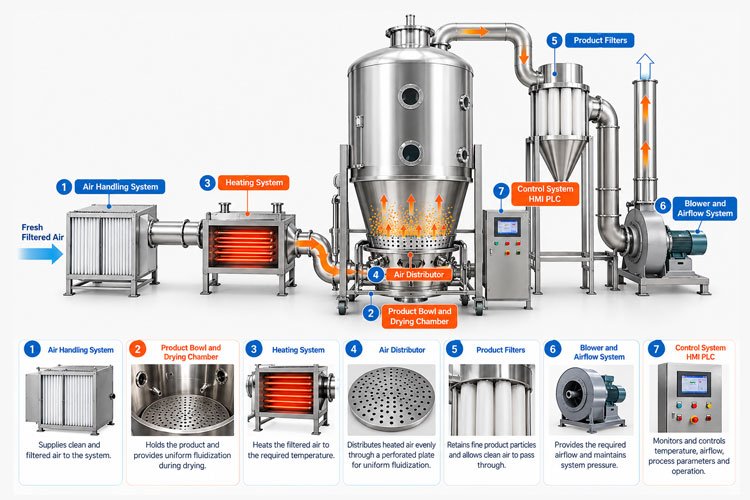
Product Bowl and Drying Chamber
The product bowl is the section in which the material is loaded. Its geometry affects the behavior of the fluidized bed. The bowl must provide adequate space for product movement and expansion while maintaining appropriate airflow conditions.
Depending on the application, product-contact components may be manufactured from stainless steel grades selected according to product compatibility and cleaning requirements. For pharmaceutical and food-processing applications, smooth and cleanable surfaces are particularly important.
Air Handling System
The air handling system controls the condition of the process air before it enters the drying chamber. A typical arrangement can include:
Air Intake → Filtration → Heating → Blower/Conditioning → Distribution → Product Bed
The exact arrangement depends on the machine design. The system may incorporate temperature control, airflow regulation, filtration monitoring and other process-control features.
Heating System
The heating system provides the thermal energy required for moisture evaporation. Possible heating arrangements include:
Electrical Heating: Electrical heaters can provide direct and controllable heating of process air.
Steam Heating: Steam-heated systems may be appropriate where a steam utility is already available at the plant.
The heating system should be selected based on the required heat duty rather than simply selecting a heater based on nominal machine capacity.
Blower and Airflow System
The blower generates the airflow required for fluidization.
Blower selection depends on:
- Required airflow
- System pressure drop
- Filter resistance
- Air distributor resistance
- Product bed characteristics
- Ducting
- Exhaust arrangement
A properly selected blower should provide the required operating point while allowing suitable process control. Oversized or undersized airflow systems can negatively affect performance.
Air Distributor
The air distributor is one of the most important components in a Fluid Bed Dryer. Its purpose is to distribute air across the product bed. A properly designed distributor helps establish consistent airflow and supports uniform fluidization.
Distributor design can depend on:
- Particle characteristics
- Product density
- Product loading
- Chamber geometry
- Required airflow
- Pressure drop
The distributor should be considered as part of the complete airflow system rather than as an isolated component.
Product Filters
Product filters prevent excessive product particles from being carried into the exhaust system. Filter selection depends on:
- Particle size
- Product characteristics
- Airflow
- Temperature
- Chemical compatibility
- Cleaning requirements
Filter loading can increase pressure drop. Therefore, differential pressure monitoring can be useful in automated equipment.
Control System
Modern Fluid Bed Dryers can incorporate automated process control. A control system monitor:
- Inlet air temperature
- Outlet air temperature
- Product temperature
- Differential pressure
- Blower operation
- Heating operation
- Drying time
- Safety interlocks
PLC and HMI systems can allow operators to define and monitor process parameters. Depending on project requirements, the system may also support recipe management, alarms, data logging and controlled sequencing. The appropriate level of automation depends on the application and customer requirements.
Types of Fluid Bed Dryers
Fluid Bed Dryers can be configured in different ways depending on process requirements.
Batch Fluid Bed Dryer
A batch Fluid Bed Dryer processes a defined quantity of material in each cycle. The wet product is loaded into a product bowl and dried until the desired endpoint is reached. Batch systems are commonly considered where:
- Production is batch-based
- Different products are processed
- Flexibility is important
- Product changeover is required
Continuous Fluid Bed Dryer
A continuous Fluid Bed Dryer continuously feeds product into the drying system and continuously removes dried material. Continuous systems can be appropriate for high-throughput processes with stable and consistent product characteristics. However, continuous drying requires careful control of:
- Feed rate
- Airflow
- Temperature
- Residence time
- Product movement
- Product discharge
Laboratory Fluid Bed Dryer
Laboratory Fluid Bed Dryers are used for:
- Research
- Formulation development
- Process development
- Product trials
- Drying studies
The objective is often to understand product behavior before moving toward larger-scale equipment. Laboratory testing can provide valuable information about:
- Fluidization behavior
- Drying characteristics
- Temperature sensitivity
- Moisture removal
- Filter behavior
- Process endpoint
Pharmaceutical, Food, Nutraceutical Industry Fluid Bed Dryer GMP
The pharmaceutical industry is one of the major application areas for fluidized-bed technology. Potential applications include drying pharmaceutical granules, powders and intermediates. Pharmaceutical applications place particular importance on:
- Product-contact materials
- Surface finish
- Cleanability
- Containment
- Filtration
- Cleaning procedures
- Documentation
- Calibration
- Process validation
- Cleaning validation
The exact requirements depend on the product, facility, process and applicable regulatory framework. A pharmaceutical Fluid Bed Dryer should therefore be engineered with the complete manufacturing process in mind.
Chemical, Agrochemical and Fertilizer Applications Non GMP
Chemical processing may involve drying:
- Crystals
- Granules
- Powders
- Chemical intermediates
- Inorganic materials
- Specialty chemicals
Material compatibility becomes especially important where the product or process environment is corrosive. The equipment design may therefore require specific stainless steel grades or other suitable materials.
Materials of Construction
The material of construction should be selected based on application requirements.
SS304:
SS304 stainless steel may be suitable for various general industrial and product-contact applications where its corrosion resistance and fabrication characteristics meet the process requirements.
SS316:
SS316 may be selected where increased corrosion resistance is desirable.
SS316 is frequently considered for certain pharmaceutical and high-purity product-contact applications because of its material characteristics and suitability for fabrication and cleaning requirements.
However, the selection of SS316L should be based on the actual process and customer specification rather than being treated as a universal requirement.
Carbon Steel
Carbon steel may be considered for suitable non-corrosive applications and non-product-contact components where appropriate.
The final MOC should be established after reviewing:
- Product chemistry
- Temperature
- Cleaning agents
- Corrosion conditions
- Product-contact requirements
- Regulatory requirements
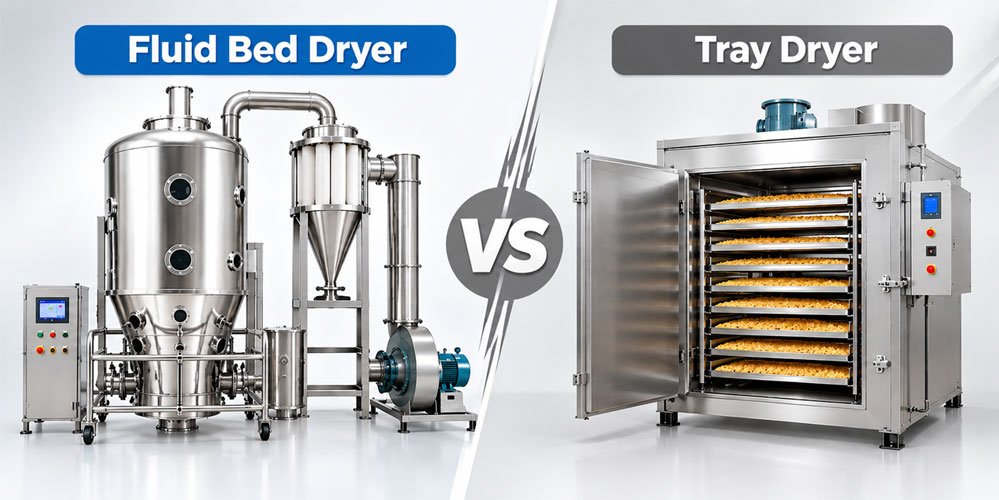
Fluid Bed Dryer vs Tray Dryer |
||
| Parameter | Fluid Bed Dryer | Tray Dryer |
| Drying Principle | Fluidized air contact | Heated air over stationary material |
| Product Movement | High | Generally low, manually |
| Heat Transfer | Typically high for suitable particles | Dependent on tray loading and airflow |
| Mass Transfer | Strong air-product interaction | More dependent on exposed surface |
| Drying Uniformity | Can be high with proper fluidization | May vary with tray position/loading |
| Automation | Can be highly automated | Can also be automated |
| Product Suitability | Best for suitable particulate materials | Broad range of materials |
| Cleaning | Depends on configuration | Depends on configuration |
| Process Flexibility | Strong for fluidizable products | Useful for materials that cannot be fluidized |
Frequently Asked Questions
1. What is a Fluid Bed Dryer?
A Fluid Bed Dryer is a drying machine that removes moisture from particulate materials by passing controlled heated air through the product bed. The airflow suspends and mixes suitable particles, creating a fluidized condition that promotes heat and mass transfer.
2. How does a Fluid Bed Dryer work?
Filtered air is heated and passed upward through a product bed. When the airflow reaches a suitable velocity, particles become fluidized. Heat is transferred from the air to the particles, moisture evaporates and humid air is removed through the exhaust system.
3. What is fluidization?
Fluidization occurs when upward-moving air provides sufficient force to suspend and move particles in a bed. The resulting particle movement improves contact between the product and drying air.
4. What products can be processed in a Fluid Bed Dryer?
Suitable products can include powders, granules, crystals and other particulate materials. Suitability depends on particle size, density, flowability, cohesion, moisture and thermal characteristics.
5. Which industries use Fluid Bed Dryers?
Fluid Bed Dryers are used in pharmaceutical, food, nutraceutical, chemical, agrochemical, fertilizer and other processing industries.
6. What is the difference between a Fluid Bed Dryer and a Tray Dryer?
A Fluid Bed Dryer suspends and mixes suitable particles using airflow, while a Tray Dryer generally dries material placed on trays. The appropriate technology depends on product characteristics and process requirements.
7. What is the difference between a Fluid Bed Dryer and a Spray Dryer?
A Fluid Bed Dryer generally processes existing particles or granules. A Spray Dryer atomizes a liquid feed into droplets and dries those droplets to produce powder.
8. Can Fluid Bed Dryers be used for pharmaceutical applications?
Yes, appropriately designed Fluid Bed Dryers can be used for pharmaceutical processing. Pharmaceutical equipment may require specific product-contact materials, surface finishes, filtration, containment, documentation and validation considerations.
9. Can heat-sensitive products be dried?
Potentially, provided the product can be processed within an acceptable thermal range. Product temperature and drying conditions must be established through process development.
10. What is the purpose of the air distributor?
The air distributor helps distribute process air across the product bed. Uniform air distribution is important for consistent fluidization and drying.
11. What is the purpose of a HEPA filter?
A HEPA filter can provide high-efficiency air filtration where required by the process or facility. Its suitability and specification depend on the application.
12. How is drying endpoint determined?
Endpoint determination can involve product moisture, product temperature, exhaust temperature, drying time or other process measurements. The appropriate endpoint method should be established for the specific product.
13. What causes poor fluidization?
Possible causes include insufficient airflow, unsuitable product characteristics, excessive bed depth, poor air distribution, product agglomeration or inappropriate loading.
14. Can Fluid Bed Dryers be customized?
Yes. Equipment can be configured according to capacity, material of construction, heating system, filtration, automation, product characteristics and other process requirements.
15. How is Fluid Bed Dryer capacity selected?
Capacity should be selected using process information such as wet batch size, moisture content, bulk density, particle characteristics, drying time and required production output.
16. What material is used for a Fluid Bed Dryer?
Common material choices include stainless steel grades such as SS304, SS316 and SS316L, depending on product compatibility and project requirements. Other materials may be used for appropriate non-product-contact components.
17. How can product carryover be reduced?
Product carryover can be addressed through appropriate airflow control, product-filter selection, filter area and equipment design. Excessive air velocity can increase entrainment.
18. Why is differential pressure monitoring useful?
Differential pressure can provide information about resistance across filters or process sections. Changes in pressure can help identify filter loading or airflow restrictions.
19. How long does Fluid Bed Drying take?
Drying time depends on the product and process conditions. Important variables include initial moisture, final moisture, temperature, airflow, particle size, bulk density and product characteristics.
20. Is a Fluid Bed Dryer suitable for sticky products?
Highly sticky materials can be challenging because they may agglomerate or adhere to surfaces. Product trials and specialized process design may be necessary.